June 09, 2026 ⏱️ 6 min
By Mihaela G. (RnD – Security Testing Group)
Artificial Intelligence is no longer just a distant concept.
It is already built into the products we make, helping automate decisions and shape user experiences every day. From recommendation engines to copilots and autonomous workflows, AI is reshaping modern software at an unprecedented pace. But as these systems become more powerful, they also become less predictable.
This article explores why Quality Assurance must evolve beyond traditional validation to ensure trust, reliability, safety, and effective AI risk management.
The AI Shift
For quite a while, the way we thought about software testing was based on a straightforward assumption. The idea was, if you give a system the same input, it should always produce the same output. Most traditional software systems tend to act in ways that are predictable, which allows QA processes to focus on validating logic, verifying flows, and ensuring consistency across clearly defined scenarios.
AI systems deviate from this model because they are data-driven, probabilistic, and often non-deterministic, meaning that the same input can lead to different outputs depending on context, model state, retrieved information, or changes in the underlying data.
This shift fundamentally changes how we think about software testing such that the main question from a QA perspective is no longer simply “Does it work properly?”, but rather “Does it behave correctly under uncertainty? Is it safe, reliable, and aligned with expectations over time?”
Managing AI Risk
AI systems introduce a new kind of risk, where the challenge is no longer limited to bugs or broken functionality. The challenge is understanding how these systems act in real-world conditions, often in ways that are harder to detect and significantly more impactful for users.
Different types of AI systems also fail in different ways, and that means QA strategies can no longer follow a single standardized approach:
- Predictive systems can drift over time, lose calibration, or behave inconsistently across user segments.
- Generative systems may produce confident but incorrect outputs, respond to malicious prompts, or generate outputs that are no longer supported by the source data.
- Agentic systems introduce another layer of complexity, as they can trigger unintended actions, execute tasks incorrectly, or make decisions outside defined boundaries.
What makes these risks particularly difficult to handle is that the most serious issues are often not the most obvious ones. In many cases, a small inaccuracy is far less dangerous than a system that sounds confident while being wrong, performs an unsafe action, or quietly fails over time in ways that only affect specific users and remain unnoticed for long periods.
Beyond Validation
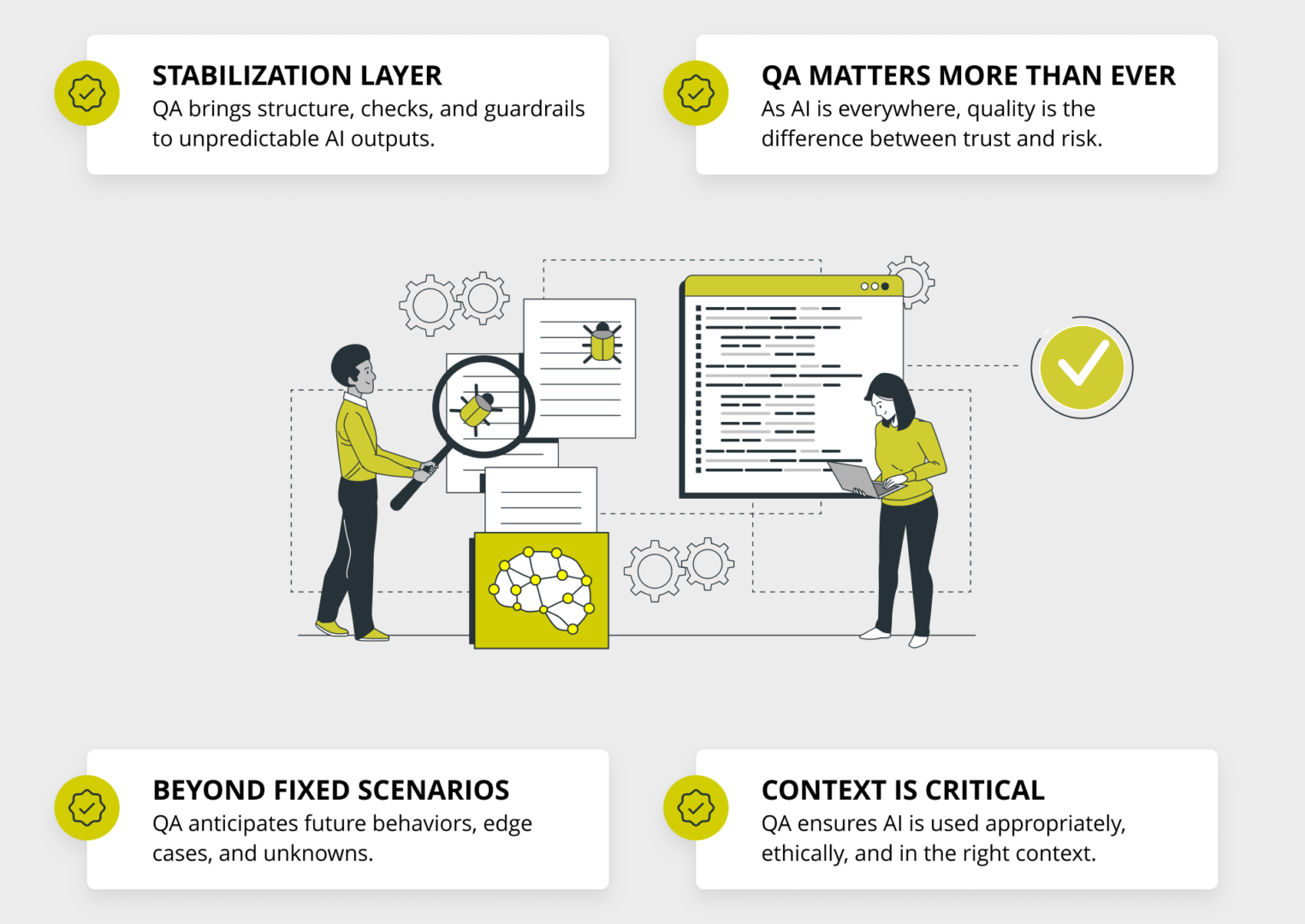
In this context, QA moves beyond simple validation and starts to look much more like risk management, where the main goal is not only to confirm that something works in a controlled environment, but to understand, control, and continuously evaluate how the system acts in real-world conditions, where uncertainty is the norm rather than the exception.
Teams are not just focused only on checking code paths and UI flows anymore. Instead, they are looking at the entire system, validating everything that influences the result. This includes things like training and evaluation data, prompts, retrieval behavior, how tools interact, human-in-the-loop decisions, and how the system behaves once it is in production. Because of this, quality cannot be assessed in isolation anymore, but only by understanding how all these components interact in practice.
This change fits in with existing industry guidelines, such as those from the National Institute of Standards and Technology and Microsoft’s Responsible AI principles. These frameworks describe what makes AI trustworthy through several dimensions: fairness, reliability and safety, privacy and security, transparency, accountability, and inclusiveness. Each of these translate into specific quality attributes that QA must actively check, rather than just taking for granted.
In this sense, QA is no longer just a final checkpoint at the end of development, but a continuous process built around two critical questions:
- Is the system safe enough to be released?
- Will it remain safe once it is in production?
Rethinking AI Testing
Testing AI systems is not about replacing traditional QA practices, but about extending them to cover behaviors that deterministic systems were never designed to handle. The testing approach changes depending on the type of system being validated, because different AI architectures introduce different risks, failure patterns, and operational challenges.
- Predictive systems require validation of calibration and consistency, ensuring that confidence scores reflect real-world correctness rather than simply producing statistically acceptable results.
- RAG-based systems must ensure that responses stay tied to retrieved information, avoiding unsupported claims or speculative outputs that can reduce trust in the system.
- Generative systems require active probing of hallucination scenarios, consistency checks across variations, and validation of how the model behaves under ambiguous or adversarial inputs.
- Agentic systems require validation of safe tool usage, reliable multi-step decision-making, and strict adherence to operational constraints and boundaries.
Beyond validating outputs, QA must also validate expectations, ensuring that system capabilities, limitations, and behaviors are clearly defined and consistently respected. This is important since trusting AI depends as much on what the system produces as on how predictable and explainable that behavior remains over time.
Security testing is evolving too, and this is reflected by standards, for example, like the OWASP Top 10 for LLM Applications, which are pointing out risks. Things like prompt injections, or handling output that is not secure, and agent overreach; these are not just minor issues anymore. Instead, they are becoming central requirements for testing in today’s AI systems.
Together, these changes force QA teams to rethink not only how AI systems are tested, but also what exactly is being tested in the first place.
One of the most important mindsets shifts in AI QA is understanding that you are no longer testing a standalone model, but an entire system composed of interconnected components that influence each other in subtle and often unpredictable ways.
Modern AI applications usually have models, data pipelines, and retrieval systems. Additionally, there are APIs, things that manage complex processes, outside tools, and mechanisms for checking performance; all of them can create problems that old testing methods might not ever find.
This is also why responsible AI cannot be seen as a separate issue, because it is deeply embedded into the engineering system itself. It brings together how things are developed, the rules that govern them, the ways they are controlled during operation, and continuous monitoring into one complete process that absolutely must be.
As a result, QA must extend beyond traditional validation and include data quality checks, observability, tracing, feedback capture, and rollback strategies, because failures in AI systems rarely originate from a single component, but rather from the interaction between multiple layers working together.
The hardest challenge is no longer building the model, but operating the system safely, reliably, and responsibly in production environments.
QA in the AI Lifecycle
AI is changing QA quite a bit, making it possible for teams to come up with test cases much quicker, identify risk areas earlier, and determine how much of the system is covered, which is important as systems get more complicated these days. This significantly accelerates many parts of the testing process.
However, this acceleration comes with an important trade-off, because AI-generated outputs require validation just like any other system output. If there is not enough oversight, they can amplify mistakes rather than prevent them. QA becomes responsible not only for validating AI-powered systems, but also for validating the tools used to test them.
In practice, this means integrating QA into the full AI lifecycle, including versioning, continuous integration and deployment, monitoring, and feedback loops. AI quality cannot be guaranteed at a single point in time, but only through continuous evaluation in production environments.
At the same time, AI systems are increasingly subject to regulatory and governance requirements, making quality not just a technical concern, but also a matter of compliance, accountability, and operational trust. Regulations, like the AI Act and GDPR for example, demand transparency, traceability, risk management, and human oversight. So, QA becomes the part of the process that puts these requirements into action in real working systems.
Responsible AI frameworks also reinforce the idea that compliance is not a final validation step, but an ongoing process that combines technical controls, monitoring, and documentation, making QA the place where governance becomes measurable and enforceable rather than theoretical. Without QA, compliance remains a concept; with QA, it becomes evidence.
Final Thoughts
We are no longer building static systems, but systems that learn, adapt, and act, making them far more capable, but also significantly more complex and less predictable than traditional software. As AI continues to evolve, testing is no longer just about identifying defects, but about understanding behavior, managing uncertainty, minimizing risk, and building trust in systems that increasingly influence real-world decisions and actions.
This shift is also transforming the role of QA itself. QA engineers are no longer just testers focused on validating functionality, but are increasingly becoming quality strategists, risk analysts, system thinkers, and AI collaborators who must understand not only how systems work, but how they behave under real-world conditions. In AI systems, correctness is no longer binary, but contextual and deeply connected to data behavior, model limitations, system interactions, and user impact.
In this new reality, QA is not losing relevance but becoming one of the most important control points in the development of lifecycle, because it determines not only whether a system works, but whether it should be trusted at all.
Îndemnul nostru
Efortul pus în programele pentru studenți completează teoria din facultate cu practica care “ne omoară”. Profitați de ocazie, participând la cât mai multe evenimente!
În cei 3 ani am lucrat la proiecte diverse ce au contribuit decisiv la evoluția mea profesională. Am colaborat strâns cu echipe remarcabile, a căror dedicare și sprijin au fost fundamentale în buna dezvoltare a lucrurilor. Cu fiecare proiect, am învățat nu doar aspecte tehnice, ci și abilități esențiale de comunicare și colaborare, reflectate în experiența mea privind interacțiunile cu clienți și modul în care o echipă eficientă operează. Aceasta este cultura companiei, de la ritmul uneori alert al zilei de lucru și practicile Agile, până la momentele relaxante de socializare cu colegii în pauzele de cafea și activități recreative precum darts și ping pong.

Am făcut cunoștință cu echipa NetRom prin intermediul programelor Internship și NetRom Software Academy, in care am descoperit că noțiunile învățate acasă au totuși aplicabilitate, chiar în cadrul unor aplicații reale. Acele experentie m-au convins să aplic pentru un job.
Mentorii foarte deschiși și colegii cu experiență care mi-au răspuns prompt la toate neclaritățile au transformat provocările în task-uri rezolvate cu succes împreună. Făcând parte din #teamnetrom mi-am depășit frica de a greși și am evoluat într-un mod echilibrat pentru mine.

Am aflat de programele NetRom de la o prezentare organizată în facultate de companie. Am decis să mă înscriu la Summer Camp din dorința de a înțelege ce anume ar presupune o cariera în IT. În urma acestui stagiu de practică, am reușit să dezvolt propria aplicație cu ajutorul mentorilor care mi-au oferit informații teoretice, dar mai ales practice, pe care nu aș fi putut sa le găsesc într-un tutorial aleatoriu de pe internet. Modul meu de abordare a aplicaților s-a schimbat odată ce am înțeles în ce constă mai exact procesul, ce presupune un mediu real de lucru și importanța muncii în echipă.

NetRom Software Testing Academy a fost punctul de plecare pentru o carieră pentru mine. Pe parcursul sesiunilor am avut oportunitatea să cunosc bazele necesare pentru asigurarea calității unui produs, urmate de o zi în companie unde am văzut teoria pusă în practică.
Recomand tuturor celor care își doresc o carieră în QA să ia în considerare această academie, fiind destinată atât celor din domeniu, dar nu numai.

Am descoperit NetRom prin intermediul unui program de internship și am fost impresionată încă de la început de mediul de lucru plăcut, de susținerea și angajamentul colegilor. A fost o oportunitate deosebită de a lucra într-o echipă de proiect, cu roluri specifice, și de a înțelege mai bine cultura companiei. Întreaga perioadă s-a dovedit o experiență valoroasă, atât din punct de vedere al cunoștințelor acumulate, cât și prin prisma relațiilor dezvoltate. În momentul în care mi s-a propus să continui ca angajat permanent, a fost o decizie ușor de luat, bucuroasă fiind să pot aplica cele învățate, dar și să adaug cunoștințe noi în fiecare zi.
